The modern architectural skyline is in danger of becoming a monotonous stream of glass and steel—sleek, yes, but devoid of soul. We’ve spent decades perfecting the art of the hermetically sealed curtain wall, only to realize we’ve inadvertently sanitized the personality out of our urban landscapes. Enter natural stone cladding: the ancient material making the most modern comeback. In this article, we will dissect the tangible, data-backed reasons why stone is once again the facade material of choice for forward-thinking architects and developers, proving that sustainability, durability, and breathtaking aesthetics are not mutually exclusive.
Walk through any newly developed business district, and you might feel a sense of disorientation. Identical glass facades reflect identical glass facades, creating a hall of mirrors that prioritizes uniformity over identity. While glass has its place, its dominance has led to a deficiency in architectural character and, often, a compromise on thermal efficiency and lifecycle costs. The search for a material that offers both performance and personality has led designers back to the very ground we walk on. What are the key benefits of using natural stone cladding on modern building facades? It is a question that challenges the status quo, offering a solution rooted in geology but designed for the future.
When we discuss lifecycle costing and sustainability, we must start with longevity. In an era of "fast fashion" architecture, where buildings are designed for obsolescence, natural stone stands as a defiant counterpoint.
There is a reason the world's most treasured historical structures—from Greek temples to Roman aqueducts—still stand. Natural stone is arguably the most durable building material available to man. Modern stone cladding systems, whether ventilated rainscreens or adhered veneers, harness this inherent strength without the weight of traditional solid masonry.
Unlike synthetic materials that can fade, warp, or degrade under UV radiation, natural stone weathers gracefully. Granite, for example, boasts a compressive strength exceeding 17,000 psi, dwarfing the roughly 5,000 psi of precast concrete alternatives . This immense strength translates to a facade that resists impact, abrasion, and the structural stresses of wind load and thermal movement.
Modern building facades are the first line of defense against nature's fury. Freeze-thaw cycles are the enemy of porous materials, causing cracking and spalling. High-quality stone cladding, particularly stones like granite, slate, and dense limestone, exhibits extremely low water absorption, making them impervious to frost damage . Furthermore, because natural stone is non-combustible, it provides an unparalleled level of fire safety, a critical consideration in contemporary high-rise design .
While durability sells the practical benefit, aesthetics sell the vision. In a post-digital world, there is a growing hunger for authenticity—a trend known as "biophilic design," which seeks to connect building occupants more closely to nature .
Manufactured materials strive for perfection; natural stone celebrates variation. No two slabs of granite, marble, or limestone are identical. The subtle shifts in color, the fossilized remnants in limestone, the veining in marble—these are not defects; they are geological autographs. Cast stone or fiber cement can mimic a pattern, but they cannot replicate the depth, translucency, and tactile variation of the real thing .
Using natural stone on a facade gives a building a unique identity. It roots the structure in its environment, particularly when local stone is used, creating a visual harmony between the built and natural landscapes . As one architectural resource notes, stone gives buildings a "face" and defines the atmosphere of public space .
Far from being a material reserved for rustic cottages, natural stone is incredibly versatile. Thanks to modern processing techniques like water-jet cutting and CNC machining, stone can be fashioned into sleek, large-format panels with crisp lines that satisfy even the most minimalist designer . Finishes range from polished (reflective and sleek) to flamed (textured and slip-resistant) and honed (matte and soft), allowing architects to fine-tune the visual weight and texture of the facade .
| Feature | Natural Stone Cladding | Manufactured/Cast Stone |
|---|---|---|
| Authenticity | Unique, geological variation; true depth . | Repetitive patterns; artificial coloring . |
| Longevity | 50+ years (often centuries with care) . | 30-40 years typical; prone to fading/cracking . |
| Maintenance | Low; occasional cleaning; no repainting . | Moderate; potential for spalling, rust streaks, color fade . |
| Fire Resistance | Non-combustible (Class A) . | Dependent on mix; may contain combustible elements . |
| Sustainability | Low embodied energy; minimal processing; recyclable . | High embodied energy (cement production); high CO2 emissions . |
To understand what are the key benefits of using natural stone cladding on modern building facades, one must look behind the stone. The real magic lies in the engineering of the ventilated rainscreen facade (VHF) .
In a modern rainscreen system, the stone panels are not glued directly to the building. Instead, they are mechanically anchored to a hidden aluminum or stainless steel substructure, creating an air cavity between the cladding and the building's insulation . This gap, typically 20mm to 50mm wide, is the key to superior building physics .
This cavity acts as a pressure-equalized zone. It continuously allows air to flow, which serves two critical functions:
This separation of structure and cladding also allows for easy integration of thick layers of insulation, far surpassing the thermal performance of solid masonry or single-skin systems.
The initial "sticker shock" of natural stone is often the biggest hurdle for project managers. However, focusing solely on the upfront cost misses the bigger financial picture.
While the initial installation of a natural stone facade can be higher than synthetic stucco or fiber cement, the life-cycle cost analysis tells a different story. A study on exterior cladding methods highlights that natural stone's longevity often makes it the most economical choice over a 50-year period .
Consider this: a cheaper facade material may need to be repainted every 5-10 years, resealed, or partially replaced every 20-30 years. These recurring costs—for scaffolding, labor, and materials—accumulate rapidly. Natural stone, properly installed, requires minimal intervention . It doesn't need painting, it resists rot, and it doesn't fade. As noted by industry experts, the investment in natural stone pays dividends through drastically reduced maintenance and replacement expenses .
There is also a "branding" benefit. A building clad in natural stone projects an image of permanence, quality, and luxury. This translates directly to higher property values, increased rental premiums, and better capital appreciation compared to buildings with lesser finishes . For corporate headquarters or high-end residential developments, stone is not just a cladding; it is a statement of intent.
In an age of stringent environmental regulations and carbon accounting, the choice of facade material is critical. Here, natural stone has a profound advantage over its manufactured rivals.
Embodied carbon—the CO2 emitted during the extraction, manufacturing, and transport of materials—is the construction industry's biggest challenge. Natural stone requires minimal processing. It is quarried, cut, and finished. There are no high-temperature kilns firing clay, no chemical reactions creating cement, and no petroleum-based resins .
The contrast with cast stone is stark. Cement, the binder in manufactured stone, is responsible for approximately 8% of global CO2 emissions. For every ton of cement produced, nearly a ton of CO2 is released . In comparison, natural stone's carbon footprint is a fraction of this, especially when sourced locally to reduce transport distances .
A ventilated stone facade is a "dry" assembly, meaning it is mechanically fixed rather than glued . This is crucial for the circular economy. At the end of a building's life, stone panels can be carefully deconstructed, not demolished. These panels can be reused directly in new projects, repurposed as paving, or crushed for aggregate . This recyclability ensures that stone doesn't end up in a landfill, unlike composite materials that are difficult to separate and downcycle.
The sustainability story doesn't stop with passive qualities. Innovations like the EcoUrban treatment use photocatalysis to create "smart" facades. When applied to natural stone, this treatment reacts with sunlight and moisture to break down airborne pollutants like NO2 and CO2. In fact, a 5,000 m² treated facade can clean as much air annually as a forest of 300 trees . This transforms the facade from a passive barrier into an active environmental cleaning system.
Modern technology has streamlined the installation of stone, mitigating previous concerns about weight and construction time.
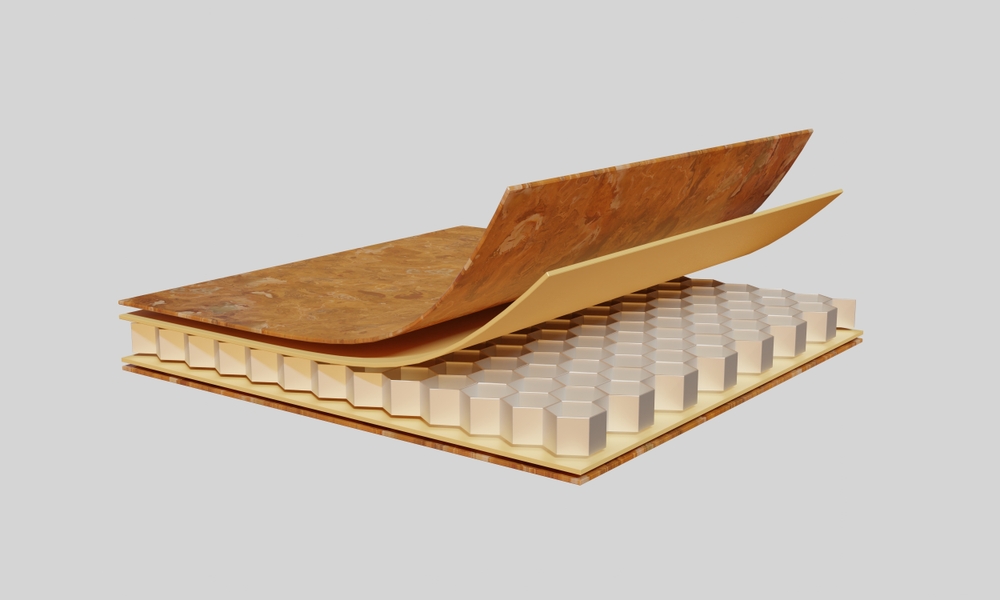
While stone is dense, modern cladding systems are surprisingly light. By using stone panels as thin as 20mm to 40mm mounted on lightweight aluminum rails, the dead load on the structure is minimized. Some systems can achieve a total weight of only 55 kg/m² , which is competitive with many heavier composite panels . For even greater weight savings, honeycomb-backed panels bond a thin stone veneer to an aluminum honeycomb core, creating large-format, ultra-light panels ideal for high-rise applications .
Ventilated facade systems are also fast to install. They are independent of the critical construction path, meaning they can be installed while interior work is ongoing . The use of adjustable brackets and pre-engineered rail systems allows for quick alignment and fixing, reducing on-site labor hours and scaffolding time compared to traditional bricklaying .
No material is perfect, and a balanced view is necessary.
Seismic and Wind Load: Modern fixings like undercut anchors and kerf systems are engineered to allow for slight movement. This flexibility means the cladding can absorb vibrations and thermal expansion without cracking, making it suitable for seismic zones and high-wind environments .
Initial Cost: As discussed, the higher CapEx (Capital Expenditure) is offset by lower OpEx (Operational Expenditure). Value engineering can be achieved by selecting locally sourced stone, using modular panel sizes to reduce waste, or combining full stone cladding on prominent elevations with other materials on secondary ones .
So, what are the key benefits of using natural stone cladding on modern building facades? The answer is multifaceted. It offers the structural honesty of a material that will outlast the building it adorns. It provides a palette of infinite aesthetic variety that connects us to the natural world. It contributes to a healthier planet through low embodied carbon and innovative pollution-fighting treatments. And, when analyzed through the lens of life-cycle costing, it is an economically prudent choice that enhances asset value.
In a world grappling with climate change and a hunger for authenticity, the glass box is no longer the default answer. Natural stone cladding is not a step backward; it is a quantum leap forward—a fusion of ancient durability with modern building science that creates facades that are not only beautiful to look at but are also intelligent, sustainable, and built to last for generations